The retail landscape and its evolving use
The UK retail sector continues to evolve under the pressures of e‑commerce, urban redevelopment and changing consumer habits.
According to a UK Parliament briefing, while retail is challenged, it remains central to local economies and high streets. {1}
Meanwhile, retail parks, particularly out‑of‑town formats, continue to attract investment: in the first half of 2025, investment in UK retail warehouses rose by 32 percent year‑on‑year, reaching approximately £1.5 billion.{2}
Retail park footfall has also shown resilience, growing by 2.0 percent year‑on‑year in February 2025. {3}
These trends confirm that high footfall, vehicular access, branding and durability are all critical demands for retail surfacing.
In this competitive and highly visible environment, surfacing is not only functional, but also part of the customer experience, brand expression, safety design and maintenance planning.
NatraTex’s coloured asphalt systems offer a way to deliver a durable, visually integrated and low‑maintenance surface that supports retail ambitions.
Meeting the competing demands of heavy use and customer experience
Retail car parks, pedestrian zones and delivery routes see intense daily use with cars, trolleys, foot traffic, deliveries and occasional manoeuvring of heavy vehicles all placing a heavy toll on public surface spaces.
At the same time, these spaces are part of the retail brand presentation. The surfacing must withstand mechanical stresses and offer a high-quality finish.
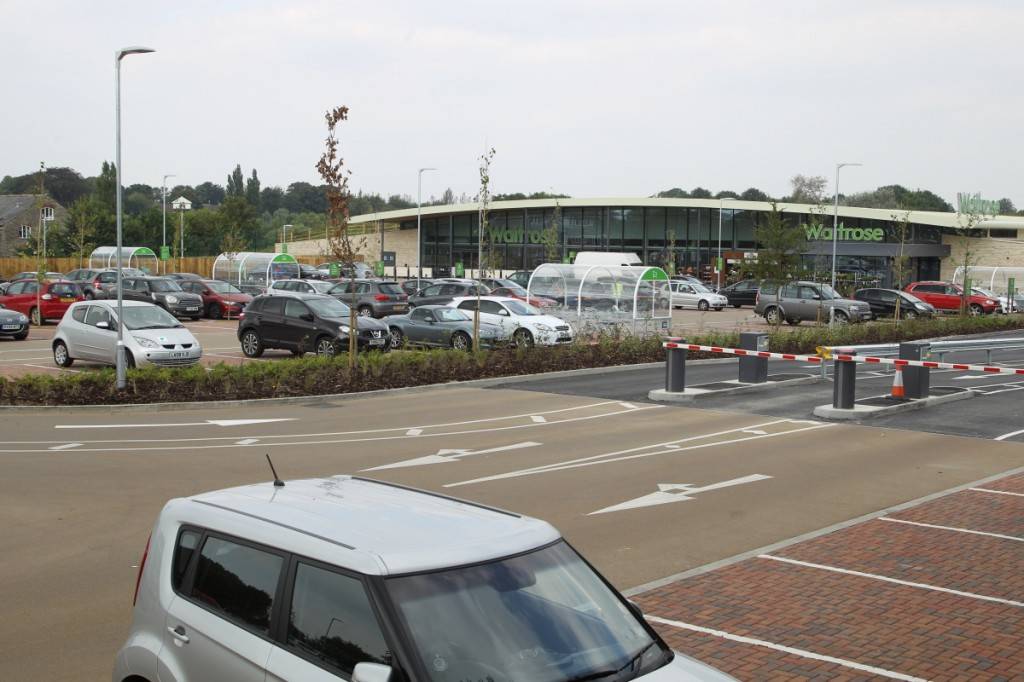
For instance, NatraTex Cotswold was selected for the Waitrose Malmesbury project for exactly this reason. The developer required a durable-coloured paving system that could handle heavy car traffic while reflecting the brand and site aesthetic. Click here to see more NatraTex
At Waitrose Malmes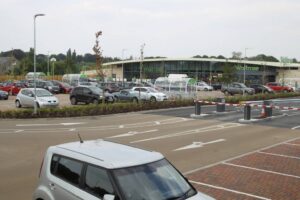 bury, the NatraTex surfacing was laid at 30 mm depth and used to differentiate pedestrian and vehicle lanes. The result improved customer safety and created a cohesive landscape aesthetic that aligned with the local context, replacing a originally proposed resin bound surfacing due to concerns over durability under heavy use.
What is clear is when considering retail surfacing, you need to balance the technical demands of traffic flow with the softer expectations of brand, legibility and experience.
Durability, wear resistance and repair strategy
Long life under stress is vital. Retail surfaces must resist rutting, surface fretting, cracking at joints, and edge damage under repeated use and dynamic loads. NatraTex’s systems are fully bonded and constructed to the same structural principles as conventional asphalt, but with added benefits of colour and surface quality. Their binder formulations are designed to lock aggregate and provide resilience against repeated loading.
A robust repair strategy is also essential. In retail settings it is common to need patch repairs, adjustments after utilities works, or updates in layout. The ability to carry out localised repairs (for example using ColdLay or small replacement sections) with minimal disruption and acceptable visual matching is a practical advantage.
Aesthetics, wayfinding and brand integration
Retail is visual. Customers notice quality, consistency and clarity in the environment. Coloured surfacing helps delineate walkways, drop‑off zones, pedestrian priority areas, disabled parking bays and landscaped edges. When designed properly, these colours and textures become part of the brand’s visual language.
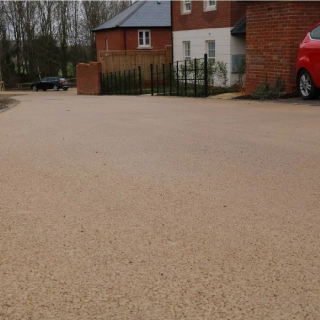
For the Waitrose Malmesbury project, NatraTex+1 the natural aggregate of the NatraTex Cotswold product complemented the local environment and harmonised with the brand’s image.
The surface was used not only as surfacing but as a visual cue separating pedestrian lanes from vehicle lanes.
For retail developers, selection of colour, contrast, texture and layout should be coordinated early with brand, signage, lighting and landscape architects to ensure coherence and legibility.
Safety, accessibility and delineation
We know retail environments have many user types: pedestrians, shopping carts, vehicles, loading zones, elderly and mobility-impaired users. Surfaces must combine skid resistance, smoothness, clear transitions and safe delineation. Coloured asphalt helps by clearly demarcating zones and enhancing visual distinction.
For car parks, the transition between vehicular and pedestrian zones is critical. Using coloured surfacing rather than painted lines reduces maintenance and avoids fading over time. NatraTex’s system locks in the aggregate, so the surface is less susceptible to flaking or paint peeling.
Practical installation in live retail environments
Retail sites are often operational during refurbishment or expansion. Surfacing systems must be installed with minimal disruption to operations, access, deliveries, customer safety and store operations.
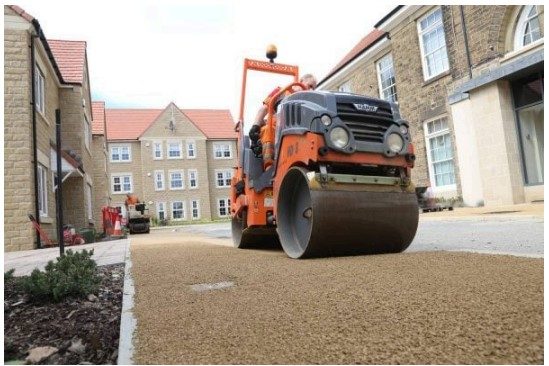
NatraTex’s asphalt-based systems can be phased, planned with temporary traffic management, and installed under standard surfacing contracts. Because they behave similarly to traditional asphalt in compaction and logistics, site teams can often work without entirely bespoke workflows.
Delivery scheduling (cold transport, staging of coloured material), coordination with shop fitters, loading docks, and lighting/landscape works must all be factored in.
The Waitrose Malmesbury project had tight demands on scheduling and material delivery, which NatraTex met via insulated transport and staged deliveries over two days.
Sustainability, life-cycle cost and carbon credentials
Retail projects are increasingly required to demonstrate sustainability credentials. The longer a surfacing lasts without costly repairs or rework, the lower its life-cycle cost and carbon footprint. Coloured asphalt is often more durable and lower maintenance than surface paints or resin systems that require recoating.
Given rising emphasis on embodied carbon, specifying a surfacing system that avoids frequent overlays or remedial works supports a stronger sustainability case in planning submissions and ESG reporting.
Durable design and low maintenance can contribute positively to life-cycle performance.
Summary checklist for retail surfacing
Considerations for Retail Surface Design:
Traffic & Load Resilience
- Can the system resist heavy vehicles, deliveries, and trolleys?
Repair Flexibility
- Can localised repairs be made with minimal disruption and maintain a visual match?
Colour, Contrast & Wayfinding
- Can zones (pedestrian, vehicle, loading) be clearly distinguished?
Safety & Skid Resistance
- Does the surface texture meet vehicle and pedestrian safety requirements?
Integration with Brand & Design
- Are materials, colours, and textures coordinated with landscape and signage?
Phasing & Installation Logistics
- Can works proceed with minimal interference to store operations?
Maintenance & Life-Cycle Cost
- What is the expected repair frequency and cost over 10–20 years?
Sustainability Credentials
- Does the specification support embodied carbon reduction and long-life performance?
Proven Performance on Retail Sites
- Are there reference projects similar in scale and environment?
Conclusion
In retail development, surfacing is more than infrastructure, it is a visual, functional and brand statement under constant use.
NatraTex coloured asphalt systems are trusted to provide a proven route to delivering durability, clarity, flexibility and integrated design in retail settings.
If you are planning surfacing works for a retail park, supermarket, shopping centre or mixed-use retail scheme, consider engaging the NatraTex team early.
We can help provide samples, review user case requirements, coordinate with branding and landscape design, and provide technical consultation to ensure a surfacing solution that stands up to the demands of use while enhancing the customer experience.
Sources
1 Research Briefings – Retail Sector Sept 2025
2 CBRE Retail Parks Report July 2025
3 BRC Retail Parks footfall bounce Feb 2025