
Why Use NatraTex for Residential Projects: A Checklist of Things to Consider
The UK continues to face a significant housing challenge, with the government estimating a need for up to 300,000 new homes per year to meet demand and reduce the backlog
The UK continues to face a significant housing challenge, with the government estimating a need for up to 300,000 new homes per year to meet demand and reduce the backlog of unmet housing needs.
In this context, residential developments must not only deliver quantity but quality. The surfacing and hard landscaping across a new development (including roads, footways, driveways and paths) makes a lasting impression, affects maintenance budgets, and influences the identity and liveability of a community.
NatraTex, as a specialist in coloured and bonded asphalt surfacing, offers a solution that bridges visual appeal, long-term performance, sustainability and regulatory compliance.
Below is a detailed, narrative “checklist” of considerations that specifiers, housing developers and local authorities should weigh when deciding whether NatraTex is right for their residential project.
In any residential scheme, the incoming roads and footpaths form a prospective homeowner’s first impression. Poor surfacing, patchy repairs or bland, utilitarian finishes can detract from a development’s value and curb appeal.
NatraTex allows for seamless integration of colour and texture from the earliest phases, enabling main access roads, shared driveways, and feature streets to have a coherent, well-considered finish.
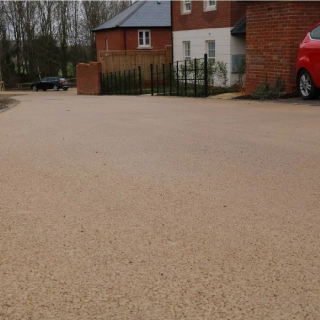
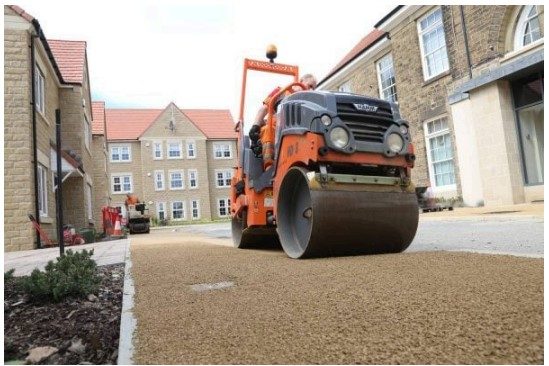
At Winchester Village for example, NatraTex Bloor Homes used 6 mm NatraTex Cotswold Classic HD on the main access routes. The coloured surfacing was integrated alongside block paving and conventional tarmac to deliver a decorative, coordinated aesthetic across the estate’s internal streets.
By specifying NatraTex early, developers can avoid “afterthought” resurfacing or piecemeal patching that disrupts the visual harmony of the estate.
Residential roads and footways see a mixture of car traffic, deliveries, bin lorries and pedestrian use. A surfacing solution must resist cracking, deformation and edge deterioration over many years.
NatraTex Cotswold is a fully-bonded asphalt wearing course, installed with the same depth and supporting layers as conventional macadam but with the benefit of a coloured, durable finish.
In the Linden Homes scheme at Cholsey Meadows in Oxfordshire, NatraTex approximately 3,000 m² of residential roads and footpaths were surfaced using 6 mm NatraTex Cotswold. The surfacing was selected for its smooth, long‑lasting finish, resistance to cracks and potholes, and minimal maintenance burden.
Over time, the reduction in reactive repairs (patching, edge breaks, colour matching) translates to lower whole-life costs and greater resident satisfaction.
Most residential schemes incorporate multiple surfacing materials e.g. block paving, concrete kerbs, resin bound areas, landscaping edges, planting strips and more.
The ability of coloured asphalt to blend or contrast elegantly complements these materials.
Because NatraTex works as an asphalt course (much like conventional macadam) its installation method allows it to tie into standard surfacing transitions cleanly, avoiding unnecessary steps or bespoke detailing.
In the case of Winchester Village NatraTex, the NatraTex finish sat alongside block paving zones and conventional tarmacadam, creating visual interest while maintaining practical transitions between different surface materials.
Developers should ensure that the chosen NatraTex colour and texture are compatible with the palette of materials across the scheme – brickwork, paving, kerbs, street furniture, drainage gullies – to create a coherent visual character.
Sustainability is an increasingly important criterion in residential development, both for regulatory compliance and market positioning. NatraTex products, particularly their “Eco” systems, employ clear binder technology and carefully sourced aggregate to minimise embodied carbon.
The durability of the surface reduces the need for frequent resurfacing or repairs, which in turn lowers carbon emissions over the lifecycle of the development.
When surfacing is long-lasting, the carbon burden of repeated repair work (hauling, machinery, overlay materials) is avoided. In public or planning submissions, being able to show that surfacing will not need heavy maintenance for many years strengthens the sustainability case.
Within residential estates, surfacing must deliver safe movement for all users, including people with wheelchairs, mobility aids, pushchairs, cyclists and pedestrians. The finish must be smooth, even, slip-resistant and without abrupt transitions or loose surface material.
Although most residential projects involve lower traffic speeds, safety remains paramount at junctions, pedestrian crossings, shared surfaces and alleyways.
NatraTex’s bonded surface ensures that aggregates remain locked in and free from fretting or shedding. The smoothness contributes to more comfortable walking surfaces, and consistent colour contrast can assist in delineation zones for visually impaired users.
By keeping surface finish consistent among roads, footways and shared zones, developers reduce trip hazards and long-term liability risks.
Even in carefully programmed schemes, there will be instances of late changes, site deliveries, snagging repairs or small patch works. It is essential to have a surfacing system that offers repair flexibility without causing long-term visual disruption.
NatraTex’s product range includes a ColdLay option for localised repairs and in-fill work, allowing patching without large-scale disruption.
Additionally, because installations proceed similarly to standard asphalt, contractors familiar with highway surfacing can handle NatraTex with minimal additional training. This reduces the risk of delays or specification errors.
During initial phases of construction, parts of the estate may need temporary surfacing or early finishes; NatraTex allows developers to create lasting surfaces early, avoiding repeated rework.
At the Winchester Village residential development by Bloor Homes NatraTex, internal roads were surfaced using 6 mm NatraTex Cotswold Classic HD on the primary access routes. The surfacing was used in conjunction with block paving and conventional tarmac to create a decorative but durable road network that complements the broader estate design.
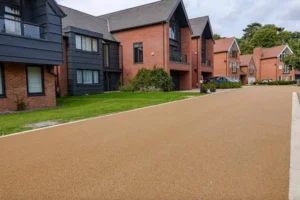
The Cholsey Meadows development by Linden Homes in Oxfordshire NatraTex used approximately 3,000 m² of NatraTex Cotswold for roads and footpaths, including a secluded area behind an electronic gate. The surfacing was selected to respect the rural setting, deliver minimal maintenance and resist cracking over time.
These examples illustrate that NatraTex is well suited not only to flagship regeneration and recreational projects, but also to everyday residential communities.
Summary checklist of considerations
| Consideration | Reasons to evaluate |
| First‑impression quality | Strong visual identity forms gateway appeal |
| Long‑term durability | Resistance to cracking, edge failure, patching |
| Material integration | Compatibility with paving, kerbs, landscaping materials |
| Carbon and embedded sustainability | Low life‑cycle carbon through durability and repair reduction |
| Accessibility and safety | Smooth, consistent surfaces safe for all users |
| Repair flexibility | Ability to patch or modify with minimal disruption |
| Contractor familiarity | Ease of installation using familiar asphalt methods |
| Proven installations in housing estates | Confidence from real-world residential schemes |
For residential developments that seek to combine aesthetics, performance and low maintenance over the long term, NatraTex offers a compelling solution. Its coloured, fully-bonded asphalt systems allow developers and specifiers to deliver identity, safety and quality without sacrificing practicality.
If you are planning or specifying a housing scheme, consider requesting samples, visiting installed developments like Winchester Village or Cholsey Meadows, or arranging a technical briefing with the NatraTex team.
Their years of experience with housing developers and planners can help ensure your estate’s surfacing contributes positively to value, satisfaction and durability.
The retail landscape and its evolving use The UK retail sector continues to evolve under the pressures of e‑commerce, urban redevelopment and changing consumer habits. According to a

The UK’s investment in grassroots and recreational facilities is expanding rapidly. Under the Government’s ‘Plan for Change,’ over £900 million has been pledged to develop sports venues and community facilities, including
With billions being invested in UK regeneration over the coming years, infrastructure decisions are under more scrutiny than ever. According to The Guardian, the government has pledged £725 billion in infrastructure